
Beneficial Electrification and Winter Storms: How Winter Peak Demand Is Changing the Energy and Utilities Industry
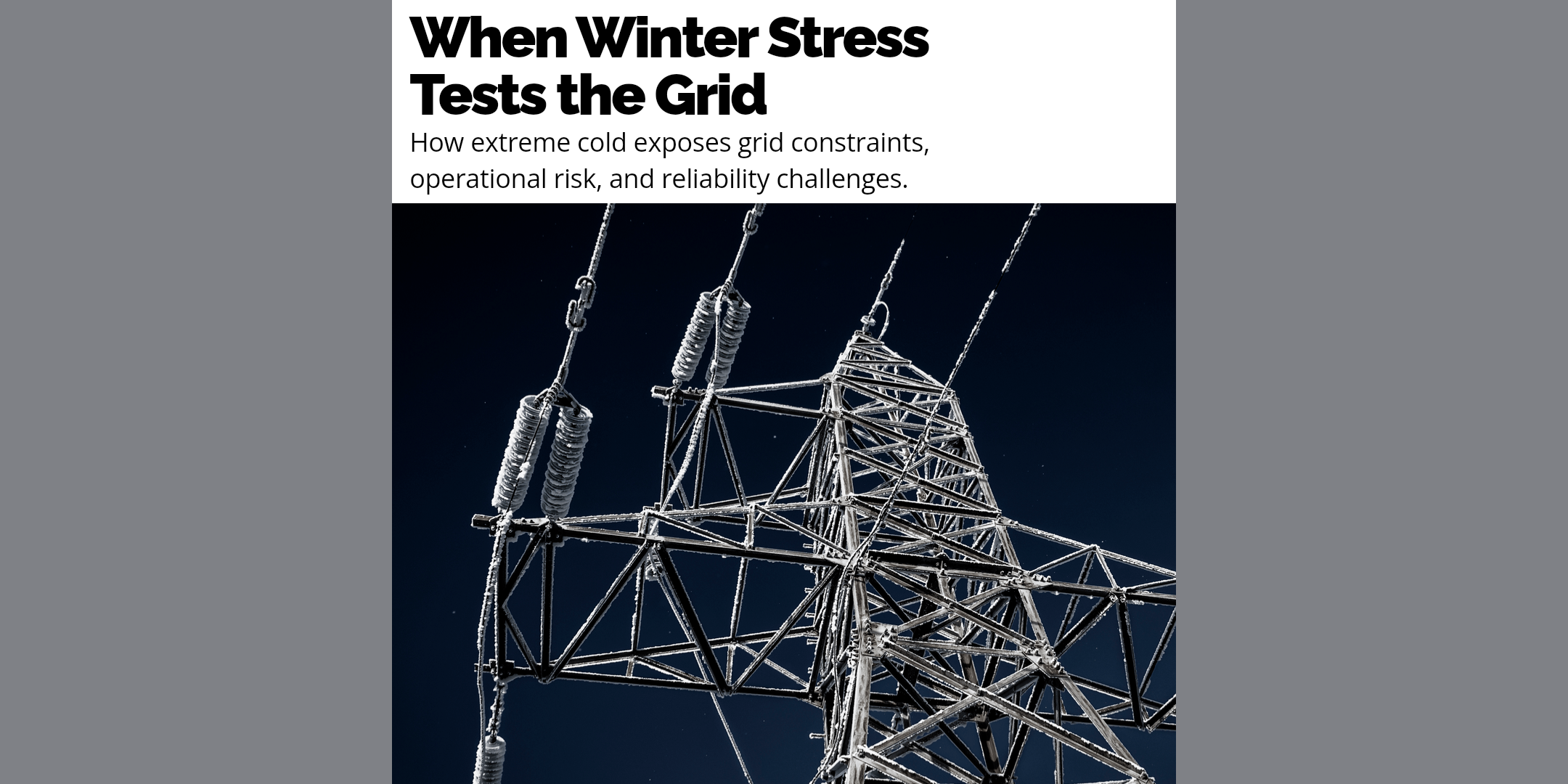
Many analysts, experts, and reporters have commented on the recent North American Storm weather event unofficially dubbed Winter Storm Fern by the Weather Channel. It’s estimated that hundreds of thousands to over a million customers lost power at various points during the event. Twenty-four states issued emergency declarations, with some going as far as banning travel on major highways and roads. Most tragically, dozens of people have lost their lives in at least 14 states; as of January 26th, 2026, the confirmed death toll stood at 50. As if these devastating impacts weren’t enough, some regions affected by Fern’s path are bracing for additional winter weather due to the potential formation of a “bomb cyclone”.
As with many past winter storms, Fern exposed fundamental trends and vulnerabilities within utility networks and systems. Notable developments included record-setting winter electricity demand forecasts across two major system operator grids, significantly reduced natural gas (“NG”) production, and degraded NG pipeline performance driven by constrained supply and low-pressure conditions. As winter storms become more disruptive and electrification expands into space heating, understanding how cold weather stress interacts with grid planning is no longer a theoretical exercise—it is becoming a practical concern for utilities, regulators, and energy users alike.
On January 26th, 2026 the Electric Reliability Council of Texas or “ERCOT”, experienced a new winter record-setting peak demand forecast of 83.8 GW. Many of the lessons-learned and best practices identified post-Winter Storm Uri enabled ERCOT to meet the expected needs of customers in Texas during this year’s Winter Storm Fern, with the maximum peak demand for the day settling at approximately 76GW. Similarly, the largest competitive wholesale electricity market and electric grid operator in the United States, the Pennsylvania-New Jersey-Maryland Interconnection, or “PJM”, experienced a winter record-setting peak demand forecast of 147.2 GW on January 27th. Much like ERCOT, the demand forecast did not materialize within PJM; the actual peak measured 137 GW the morning of January 27th.
Winter storms create serious issues for utility distribution grids. Heavy snowfall and/or winds can down powerlines, poles, and damage infrastructure. But aside from these typical problems, there are more “big picture” dilemmas at hand. As there is more focus on electrification, such as air-source heat pumps discussed in previous Peak Utility Advisors blog posts, it’s important to understand the risk to electrical grids, whether they be transmission or distribution (utility) grids. From a system perspective, the challenge is not the efficiency of heat pumps themselves, but the magnitude and timing of the electric load they create during extreme cold events.
In the case of Texas and its grid operator ERCOT, many households are electrified to some degree. Because of the limited need for year-round heat for most homes, the majority (61%) of households in the state use electricity as the fuel source for heating. Electric heating is often much more modular and requires much less infrastructure such as piping. For this reason, of the installed electric-heat systems, only 19% are based on heat pump technology, which is inherently more efficient than electric resistance heating. In fact, according to the U.S. Department of Energy (“DOE”), an air-source heat pump, or “ASHP”, can provide the same heating using only about 25% of the electrical energy. In other words, about 42% of households in TX are using resistance heating, which works very similarly to a toaster, and is extremely inefficient. This leaves ERCOT extremely susceptible to “peaky” or “spiky” electrical peak demand. And these vulnerabilities are not unique to Texas; the PJM Interconnection—covering 13 states from Illinois to New Jersey—is facing its own 'winter-peaking' crisis as states aggressively transition from natural gas to electric heat.
In the PJM footprint, roughly 25% to 30% of homes now rely on electric heat, leading to the grid operator to forecast record-setting peak demand during Winter Storm Fern, in order to account for the increased load. Unlike Texas, PJM’s challenge is 'Cold Load Pickup,' where the efficiency of even high-performance heat pumps can drop from a ratio of as high as 4-to-1 (heat energy output versus electrical energy consumed) to 1-to-1 during extreme sub-zero temperatures. This effectively turns a significant proportion of a region's heating fleet into a massive, synchronized resistance load that can threaten grid reserve margins. With those diminished margins, prices rose drastically, which led to the incredible price spikes in some Virginia grid nodes that peaked at over $1,800 per MWh of electricity.
While electric peak demands were troubling, equally problematic were the significant cuts to natural gas production as a result of freeze-offs. According to the U.S. Energy Information Agency (“EIA”), a natural gas freeze-off is the blockage of oil and gas equipment, such as wellheads and pipelines, caused by freezing temperatures that turn water and hydrocarbons within the, raw, unprocessed gas stream into solid ice or hydrates. This common, winter-related event halts production and can lead to significant supply disruptions and price spikes. In the case of Winter Storm Fern, total natural gas production fell at least 9%, with some organizations, such as Bloomberg, reporting a 12% reduction in supply. As a result, spot (or real-time) prices at the Henry Hub in Louisiana, a major trading location, rose from $3.06 per MMBtu (or Dekatherms-Dth) on January 16th to $30.72/MMBtu on January 23rd (the Friday leading up to the storm). Even more drastic were the price spikes in the Northeast, with several trading locations experiencing spot prices at levels near $150/MMBtu. Natural gas can be stored above-or-underground, and some utilities were able to procure NG at lower prices than the spot market but there is no doubt that many will see drastically higher bills in the upcoming months.
Supply disruptions don’t just lead to higher prices; they can also lead to significant infrastructure and pipeline constraints. For example, the Texas Eastern Transmission and ETC Tiger Pipelines both issued “underperformance notices” on January 25th. In addition to its use as a residential heating source, many power plants use NG to produce electricity. And, when supplies are low enough from reduced upstream production, it becomes difficult to provide NG at sufficient pressure to fuel them. Whether the fuel be used in a combined-cycle plant—a high-efficiency system that reuses waste heat—or in lower capital cost but inefficient peaker plants, supply disruptions drastically affect the economics and operations of these plants, contributing to many of the rolling blackouts experienced throughout the country.
In fact, during Fern, conditions got so bad that PJM reported almost 21GW of electricity generation capacity, or almost 14.2% of the forecasted demand, was down on January 25th. Based on data from GridStatus.io, about 10GW of the downed power plants were natural gas-fired (an additional 5 GW were either coal or oil-fired). Other forms of electricity generation were unable to produce power as well, but fossil fuel plants were among the largest contributors.
Robinson Meyer, an award winning journalist argues that much of the weakness or softness in our electrical grids has been worsened by inadequate policy action toward resilience and storm hardening. Independent of ongoing debate around the underlying drivers of climate trends, insurers and risk analysts are increasingly responding to observable changes in weather severity and frequency. One report by Swiss Re, recently detailed that between 2021 and 2025, the average annual insured loss in the U.S. from winter storms reached over USD 7 billion, compared to an average of just USD 2 billion between 2011 and 2020. Early estimates by analysts approximate that the insured damages from Winter Storm Fern will match or eclipse those from Uri, which were approximately $15-18 billion. Some costs are uninsurable or uninsured, and AccuWeather estimates economic damages of $105B to $115B as a result of the storm. There is no question, winter weather extremes do appear to be causing more damage in recent years. Nevertheless, is it the fault of bad policy towards storm preparedness that has led to these failures of our utility infrastructure?
Meyer’s article makes some excellent points, and they’re corroborated by recent reports detailing learning lessons from catastrophic winter storm failures. Various official reports from the state of Texas, including those from the Texas Comptroller, ERCOT, and the State Legislature, analyzed the catastrophic failure of the grid during Winter Storm Uri (February 2021). Three primary takeaways from the event included vulnerabilities in the NG supply chain, failure to winterize and failure of winterization equipment/packages, and inability to accurately predict peak demand. In the case of Uri, when natural gas production dropped, limiting supply in transmission and distribution networks, some NG processing facilities were taken off of grid power, greatly limiting their ability to continue supplying the utility pipeline network. This created a reinforcing “death spiral”, only exacerbated by the lack of or failure of winterization equipment and packages. Many NG power plants lacked virtually any insulation due to Texas’ warm climate. Additionally, many wind turbines lacked winterization packages or the packages failed during the storm. All-in-all, a combination of freezing instruments, frozen water pipes for steam generation, and ice on wind turbine blades caused a massive loss of generation across all fuel types (gas, coal, nuclear, and wind). In fact, the Federal Energy Regulatory Commission (“FERC”) found that 81% of freeze-related outages occurred at temperatures above the units' stated design limits, meaning the equipment failed earlier than it should have.
Nonetheless, the Heatmap News Founding Editor highlighted extremely important themes in the current utilities industry. Many states have made significant long-term changes towards clean energy transitions. With the changing climate and increased frequency of previously called “100-year” winter storms, policy has not kept up with the new requirements for grid resilience and infrastructure stress. Absent coordinated planning that accounts for winter peak demand, these dynamics are likely to repeat regardless of the exact generation mix. In order to protect the vulnerable who suffer more during prolonged outages, and include such groups as the elderly, low-income households, as well as people without adequate heating, significant improvements are required. With data from multiple winter storms, there is significant evidence that fossil fuel infrastructure has systemic weaknesses in warm climates that infrequently exhibit freezing temperatures.
Peak Utility Advisors supports some but not all of Meyer’s conclusions. This perspective reflects an analytical assessment of how these issues intersect with utility system planning, cost exposure, and operational risk, rather than an endorsement of any specific policy outcome. While they have faced controversy in recent months, there might be a beneficial role for capacity markets to play in areas that exhibit extreme cold events. There are issues with the system operator model in the U.S. but market-creation typically leads to better outcomes than increasing regulation in an extremely regulated space, as was exhibited with the Acid Rain Program (“ARP”) which established a permanent emissions cap-and-trade system for sulfur dioxide (SO2). If the value of energy supply during emergencies can be captured, the entire energy/utility system can be incentivized year-round to provide power regardless of weather conditions, leading to increased but efficient investment in electrical grid and supporting infrastructure. It’s the opinion of PUA that these systemic changes would be significantly more beneficial to ratepayers, through prevention or alleviation of rolling blackouts, than top-down diversion of power from large commercial and industrial customers such as data centers and manufacturing plants.
Viewed through this lens, recent winter reliability challenges are less the result of poor decision-making and more a predictable outcome of market structures that do not provide sustained incentives for investments whose value is realized primarily during rare but severe cold events. In the absence of mechanisms that compensate generation availability, storage, or demand flexibility during extreme winter conditions, such investments are unlikely to clear traditional planning and probability models — even when their system value becomes evident every few years. As a result, reliability during extreme cold is often treated as an exception rather than a compensated service, despite its outsized impact when those conditions occur.
Peak Utility Advisors helps businesses and building owners understand utility cost drivers, reliability risks, and evolving energy system dynamics. To discuss how winter peak demand, electrification, and market structures may affect your operations or long-term planning, contact matt.jochym@peakutilityadvisors.com or (970) 235-1098.
