
Proposed PJM Backstop Auction: What it is, and How it Works
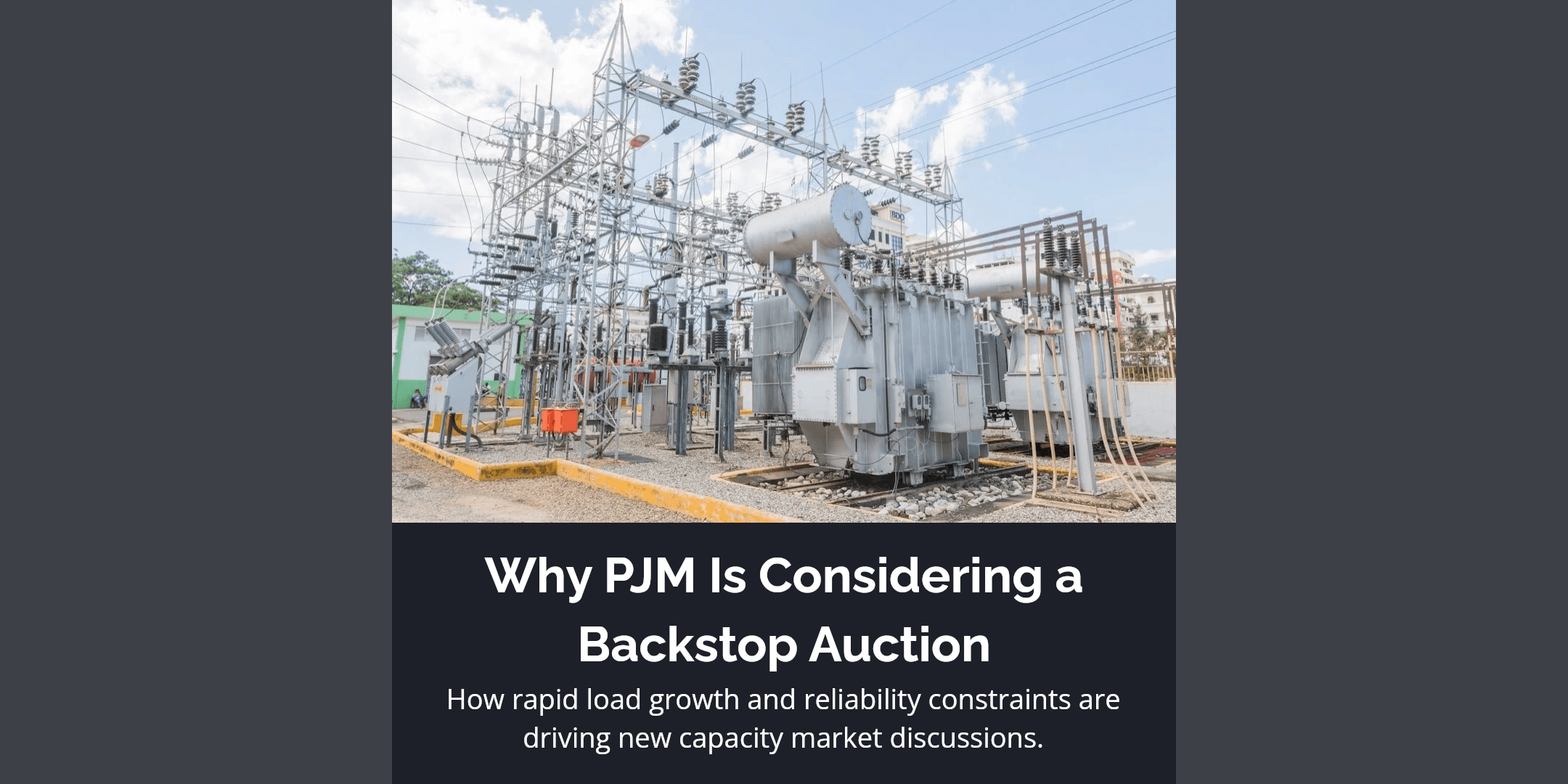
On January 28, 2026, Reuters reported that the PJM Interconnection, the grid operator for the largest U.S. power market, has begun discussions about establishing a “special” or backstop auction to help ensure supply adequacy in the face of rapidly rising demand — largely from hyperscale data centers and other large electric loads. This backstop would act as a supplement to PJM’s existing capacity market if normal auctions fail to secure sufficient resources.
To understand what a backstop procurement auction is and how it might work, it helps to look at how PJM’s capacity market is structured and where backstops fit in:
1. Primary Capacity Market: Reliability Pricing Model (RPM)
PJM’s core mechanism for ensuring future grid reliability is its Reliability Pricing Model (RPM) capacity market. This is a forward auction platform where generation resources (and demand response) commit to being available to meet forecasted peak demand several years ahead. The RPM system features include:
Base Residual Auction (BRA): This foundational auction procures the bulk of capacity years in advance (typically three years).
Incremental Auctions: These follow if additional or replacement capacity is needed for the upcoming delivery year.
Locational Deliverability Areas (LDAs): The market is divided into zones with separate reliability requirements and pricing curves.
The BRA and its incremental follow-ups form the first level of resource adequacy procurement, setting forward price signals and clearing capacity to meet expected peaks.
2. Reliability Backstop Mechanism
To guard against circumstances where RPM auctions clear below targeted reliability thresholds (i.e., they don’t procure enough capacity to meet the forecasted peak demand plus reserve margin), PJM’s tariff and market manuals include a Reliability Backstop provision. This mechanism is intended to fill gaps when standard auctions do not fully satisfy the resource adequacy criteria.
How a Reliability Backstop Auction Works (Conceptually):
Trigger Conditions: A backstop is designed to be activated when capacity commitments from the RPM auctions fall short of the reliability requirement, or when near-term transmission deliverability constraints emerge after an auction. For example, a backstop could be triggered if total committed capacity is insufficient to meet forecasted peak demand plus the required reserve margin.
Procurement Objective: Once triggered, this mechanism would procure additional capacity through a targeted auction or directed contracts to ensure reliability is restored.
Clearing Rules: Under discussions reported in policy and industry coverage, the backstop auction would allow competitive bids from capacity providers such as thermal generation and storage resources (e.g., battery projects that can meet deliverability and reliability needs). These bids would be evaluated competitively to fill the shortfall without relying on the standard RPM clearing curves.
Contract Terms: Proposals circulating among government offices and PJM stakeholders have suggested that capacity procured through a backstop mechanism could be contracted on longer-term commitments, with cost allocation mechanisms tied to the loads driving demand growth. For example, a Statement of Principles circulated by the White House and governors calls for a backstop auction with commitments extending up to 15 years, and cost allocation to include load-serving entities (utility companies) with large new loads that have not otherwise procured capacity.
3. Relationship to Regular RPM Auctions
In effect, the backstop auction adds a second layer beneath the regular auction structure:
Level 1: Regular RPM auctions clear capacity and set pricing.
Level 2: If that market fails to procure enough capacity to meet reliability criteria, the backstop mechanism would be triggered to procure additional targeted capacity.
In some policy proposals, this could lead to longer contract durations and potentially different price formation rules, especially for newly built generation needed to maintain reliability.
In other words, the backstop is less of a replacement and more of a safety valve: it engages only after the normal capacity market framework proves unable to deliver sufficient committed supply — and it could introduce constrained procurement or targeted auctions to bring new resources online faster.
Note: While PJM has begun stakeholder discussions about the idea and federal/state officials have called for an emergency version of such an auction, any formal backstop auction design would still require approval by the Federal Energy Regulatory Commission (“FERC”) before implementation.
