
Utilities Controversy in the Springs: Why Would Colorado Springs Utilities Propose an Additional Charge for Solar Customers?

Back on August 22, 2025, Colorado Springs Utilities (“CSU”) notified their net-metering customers via email of a proposed demand charge scheduled to take effect in January 2027. Their explanation was that the new charge would “ensure that rates reflect the true cost of delivering electricity, especially during peak demand periods”. The solar user community quickly began to organize, and the proposed charge was removed from the 2026 rate case (for 2027) following a City Council hearing and a tight 5–4 vote. With around 9,000 Springs residents utilizing solar power, they represent a significant local voting contingent. So why would CSU propose a new charge such as the proposed demand charge? Was it greed? Well, CSU is a locally-owned, municipal not-for-profit utility. In addition, along with the “Energy Wise” Time-of-Use changes that CSU has proposed for 2027, the solar demand charge would have been revenue-neutral (thus not increasing the size of the municipal utility). In order to understand the technical and economic issues at hand, some additional background information is required.
First and foremost, electrical grids must be electrically balanced continuously, on a millisecond-by-millisecond basis, to maintain system frequency within tight operational limits. Without going too far into the details about electrical power, our national electrical grid is built almost entirely on alternating current (“AC”) that oscillates both voltage and current, typically following a sine wave pattern. The number of repetitions of the full wave pattern is referred to as the frequency and is measured in hertz (Hz). In the United States, power is typically distributed at 60 Hz. Now what’s important is that in order for all of our devices and equipment to work properly—whether hard-wired or plugged into an outlet—and to avoid rolling blackouts, system frequency must stay within very tight operating limits (typically ±0.05 Hz), which requires utilities to carefully balance supply and demand at all times.
On-site solar photovoltaic systems produce power in direct current (“DC”) that is then converted to AC at the system’s inverter. Understandably, power is produced when the sun shines during daylight hours. When enough solar power installations (utility-scale, commercial, or residential) are producing excess power at the same time within a utilities distribution grid and possibly throughout the region, the exported power on both networks is relatively inexpensive. One might think, “that’s a great thing”, right?
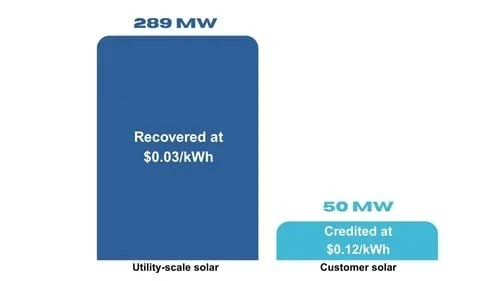
Image Credit: Colorado Springs Utilities
Well, that’s where things get complicated. Net metering programs typically offset the cost of a kilowatt-hour (“kWh”) exported by a solar customer’s system on a 1-to-1 basis. Meaning, that even though the power produced at that time is of relatively lower value, as discussed above, it’s credited at the utility’s base rate (higher value). Why is that a problem? Unfortunately, when the utility is forced to buy power at a more expensive price than it is worth, rates rise comparatively for non-solar ratepayers. Solar users still use power during the 5-9PM window when power is relatively more expensive for the utility to procure or produce. Then under the flat rate structure, credits are applied on a 1-for-1 basis and lead to increased costs for non-solar ratepayers.
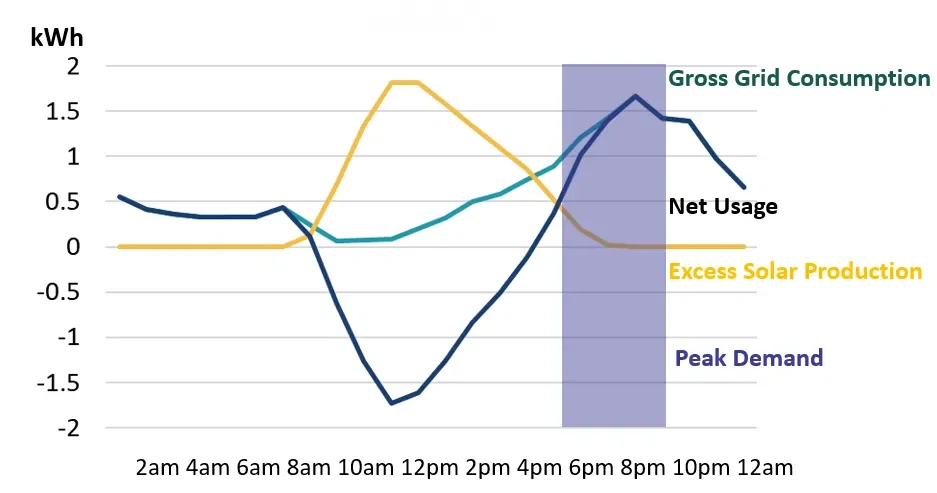
Image Credit: Colorado Springs Utilities
So, as CSU Chief Financial Officer Tristan Gearhart explained, the issue wasn’t solar adoption itself, but a growing mismatch in how system costs were being recovered.
“As [CSU has] gone back and reviewed our costs, we’ve seen a significant shift in where those costs are occurring,” Gearhart said. “We’ve identified roughly $5.5 million that’s being paid by one group of customers, but not by others.”
In other words, CSU concluded that non-solar customers were increasingly covering system costs associated with peak demand—costs that solar customers still contribute to during evening hours.
“We have to take action to make sure we’re addressing that,” Gearhart continued. “All of our rates are subject to change, and City Council is ultimately the body that has to make those decisions.”
As a municipally owned, not-for-profit utility, CSU’s leadership emphasized that its role is not to maximize revenue, but to accurately reflect the true costs associated with operating the system.
“It’s our responsibility as a utility to provide the best possible information about what it actually costs to operate our system,” Gearhart said.
As a not-for-profit organization, Gearhart and CSU wanted to ensure fairness for non-solar customers essentially paying for the difference in value of the credits that solar users receive during the day, or non-peak hours. According to CSU’s calculations, the annual difference between the value of the power produced during daylight hours (off-peak) and the value of electricity during the 5-9PM peak was $616 per customer. And as a result, the utility suggested a demand charge that would result in an approximately $51/month average bill increase for solar users taking service from CSU. Had the newly proposed Energy Wise rates and solar user demand charges both been approved, non-solar customers would have saved $2 per month, on average.
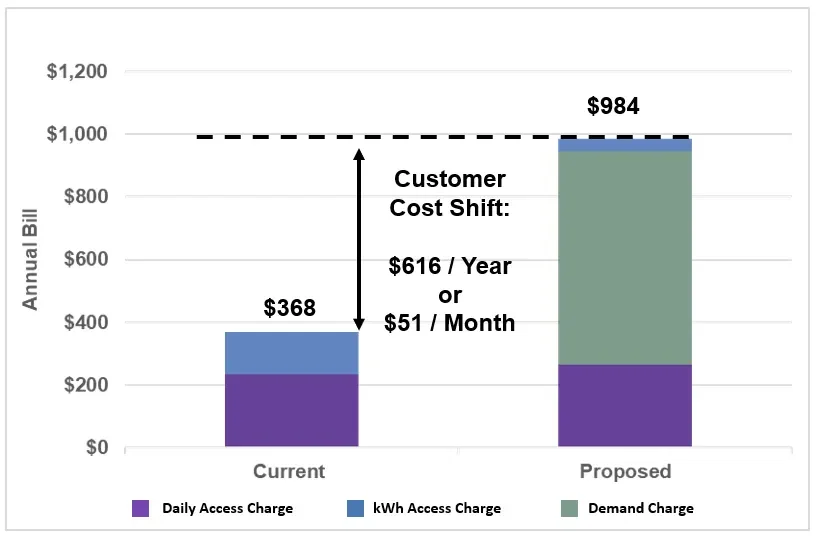
Image Credit: Pikes Peak Television, Inc.
One point of interest for Peak Utility Advisors was why CSU did not consider the approach taken by Xcel Energy instead of the proposed demand charge. To their credit, Xcel has found a middle ground by transitioning customers to Time-of-Use rates (unless they opt-out) and crediting the kWh exported based on the hours that their solar power systems produced the energy. With CSU already proposing their “Energy Wise time-of-day rates”, this approach may have created less controversy.
On the CSU website, the utility addressed this issue directly in the FAQ section of its “Proposed Net Metering Changes” page. There, CSU responds to the question, “Why not just move solar customers to Energy Wise rates?” by stating:
“While kWh usage is measured and applied to energy rates and credits, it doesn’t fully capture the cost of maintaining grid readiness for high-demand moments. The demand charge better reflects the infrastructure and capacity costs associated with peak demand.”
In other words, electricity demand during the 5–9 PM peak more directly reflects the infrastructure investments required to build, maintain, and operate the grid. This principle is well understood in the industry. That said, similar price signals could also be reflected through time-differentiated energy credits or other rate design adjustments, rather than a standalone demand charge—potentially simplifying ratepayer understanding while achieving the same objective with less controversy.
In summary, many—if not most—ratepayers in Colorado support cleaner energy. However, as renewable energy penetration continues to rise, the economic structures underpinning utility programs will need to evolve to more accurately reflect the value of clean energy exported to the grid, while also ensuring that customers who are unable to invest in on-site solar—whether for technical or financial reasons—are not unfairly penalized.
One potential approach is to more aggressively promote the installation of battery storage, both on-site and at the utility scale. At the same time, it is important to acknowledge that, in the long term, continuing to compensate electricity exported by residential solar systems at rates equivalent to standard base rates may not be feasible.
If your business or multi-family property (Condo, Co-op, etc.) already has a solar energy system installed and you are unsure if Time-of-Use (TOU) or flat rates are less expensive, feel free to reach out to Peak Utility Advisors at the contact information below for more information.
Contact Information:
Matt Jochym
Advisor/Founder
(M): 970-235-1098
(E): matt.jochym@peakutilityadvisors.com
peakutilityadvisors.com/form

